When AI Money Runs Out, the Bill Comes Due
(14)
Overview
Capital markets are starting to question AI capex ROI. When cheap money funded AI pilots, few asked if they moved the P&L. When scrutiny returns, the gap between automated dysfunction and redesigned operating models becomes visible, and expensive.
Year
2026
Industry
Financial Services / Cross-industry

Challenge
Forrester's latest research found that enterprises are now postponing a quarter of their planned AI spend into next year, as financial scrutiny catches up with a wave of pilots that got funded fast and unquestioned. Gartner backs that up from another angle: fewer than a third of corporate decision-makers can point to a specific financial outcome tied to their AI investment. The pattern is one financial services has seen before, money gets deployed under a plausible story, and the story gets checked much later than the money got spent. The story most AI pilots were funded on wasn't really about the customer. It was an internal efficiency case, faster process, fewer hours, lower cost, dressed up as impact. Nobody asked whether the customer was actually better off, because nobody had to. The capital was there, the competitive-pressure argument was compelling, and finance signed off on urgency instead of evidence.
Impact
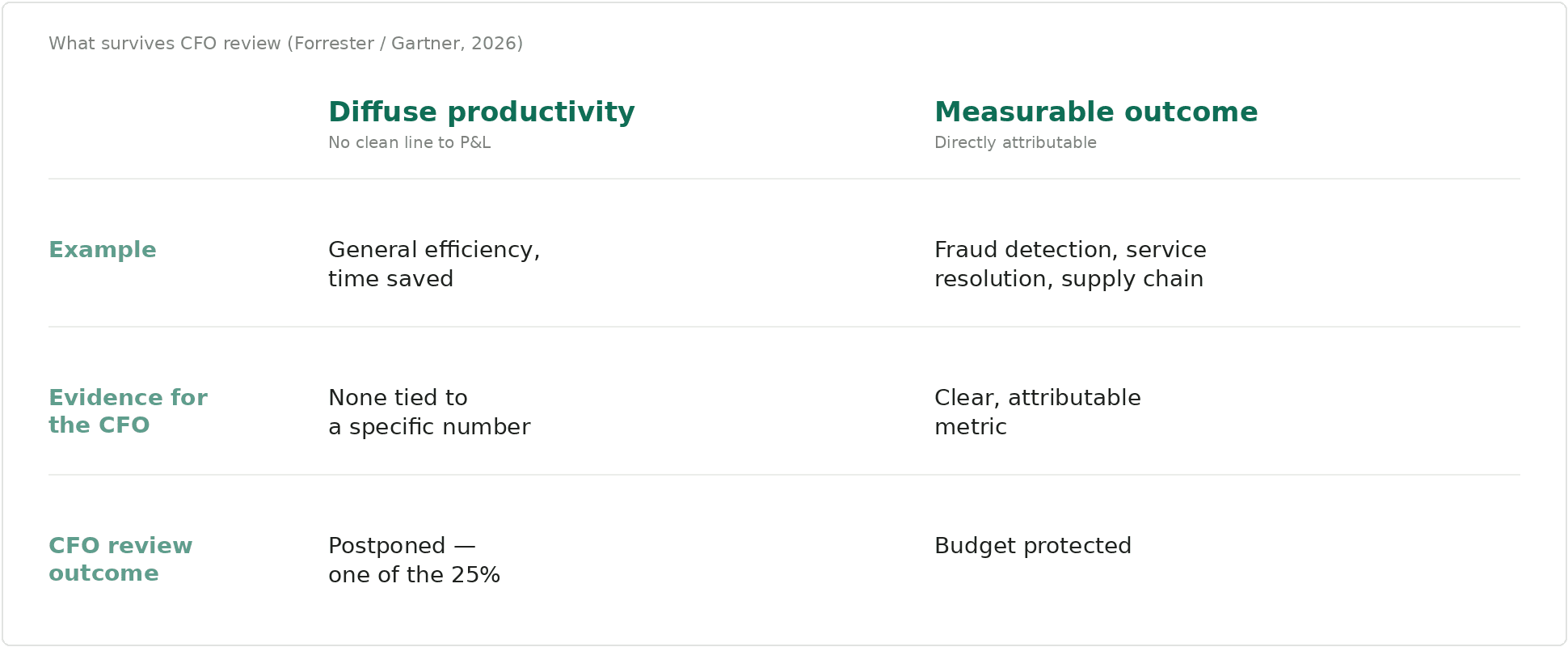
That's the gap now getting priced. Forrester's data shows exactly which pilots are surviving the CFO review and which aren't: applications tied to a directly measurable outcome, fraud detection, customer service resolution, supply chain accuracy, are holding their budget. Applications that only delivered diffuse internal productivity, with no clean line to a P&L number or a customer outcome, are the ones getting postponed. For whoever signed off on the pilot, that's not an abstract institutional risk anymore, it's a specific conversation with their name on it. The operating model question was never optional; it was just cheap enough to skip. Institutions that redesigned around actual customer value before automating can answer the CFO's question directly. The ones that automated an internal efficiency story are the 25% getting cut, and the person who greenlit it is the one explaining why.